Showing posts with label Energy independence. Show all posts

Wednesday, July 18, 2012

Cashton Greens Community Wind Project Plows New Ground

Immediate release: July 18, 2012

More information:
Michael Vickerman Director, Program and Policy
608.255.4044, ext. 2, mvickerman@renewwisconsin.org

 Two-turbine project sets a number of firsts for Wisconsin


 A vision of Wisconsin’s renewable energy future came to life with the dedication today of the two-turbine Cashton Greens Wind Farm, Wisconsin‘s first community wind development. This five megawatt project rises alongside Organic Valley Cooperative’s distribution center in this village 40 miles southeast of La Crosse.

Owned by La Farge-based Organic Valley Cooperative and Gunderson Lutheran Health System, La Crosse, Cashton Greens will generate enough electricity to offset the energy use for Organic Valley’s corporate headquarters and distribution center, as well as 5% of Gundersen Lutheran’s energy needs.

“This ground-breaking community wind project represents a number of firsts for Wisconsin,” said Michael Vickerman, director of programs and policies for RENEW Wisconsin, a renewable energy advocacy organization.

“Cashton Greens is both Wisconsin’s largest customer-owned renewable energy installation and the largest ever to receive a grant from Focus on Energy, the state’s energy efficiency and renewable energy program,” Vickerman said. It is also the first wind project permitted following the enactment of Wisconsin’s three-year-old wind siting law (2009 Act 40).The Village of Cashton approved the project in June 2010.

“RENEW and all of our members salute the team of Organic Valley, Gundersen Lutheran, and the village of Cashton for their audacious commitment to energy independence,” said Vickerman. “They are plowing ground that will result in new renewable energy systems supporting Wisconsin’s economic vitality while protecting its environmental health.”

“This project clearly shows that Wisconsin energy customers are eager to move forward to reduce their use of fossil fuels. Rather than wait for their utilities to act, many of them are now taking the initiative and installing systems to supply their own businesses and residences with clean renewable energy produced,” he said.

Organic Valley is America’s largest cooperative of organic farmers and one of the nation’s leading organic brands. Gundersen Health System provides health services to its patients at is hospital and clinics throughout west Wisconsin, southeast Minnesota, and northeast Iowa.

-END-

RENEW Wisconsin is an independent, nonprofit 501(c)(3) organization that leads and represents businesses, organizations, and individuals who seek more clean renewable energy in Wisconsin. More information on RENEW’s Web site at www.renewwisconsin.org.

Friday, August 26, 2011

Wind turbine to produce electricity for Random Lake farm

From an article by Bob Petrie in the Sheboygan Press:

TOWN OF SHERMAN — It's a tall order for the 120-foot wind turbine that towers over the Preder farm on county Highway I just outside Random Lake.

The turbine, installed this week on a small hill behind the farmhouse, is expected to produce all the power needed to run the household and the farming operation, with a little bit left over for the neighbors.

"We're trying to make it so that we're not relying on everybody else for energy," said Mike Preder, 32, who helps his father, Jeff, and mother, Kathy, raise growth hormone free Piedmontese cattle and free-range chickens on the 140 acre property.

Ed Ritger, a Random Lake attorney and the Preders' next-door neighbor, is financing the $500,000 tower, with about half of the cost covered through grants offered from the federal government and Focus on Energy. Ritger, who owns a hobby farm, looks at the turbine as an investment that will pay for itself during a 10- to 15-year period, and be around to produce energy for a lot longer.

"It's an investment, but it's also an opportunity to send a message that we need to do more renewable energy," said Ritger, 64. "That's a message I've been preaching for a long time. So my wife and I are putting some dollars behind that message."

The building in Random Lake where Ritger's law firm is housed was equipped about a decade ago with solar panels. The panels power the building, and the excess electricity goes back to the power grid. He thought it would be a good idea to try building a turbine out in the country, and the Preders were receptive to the idea.

"We've been neighbors for 40 years, and you can't put a wind turbine in the valley, (you) put it on the best hill that you've got," Ritger said. "So that's how this joint venture was put together; the Preders providing the site and the Ritgers providing the capital."

The Preders, whose energy bills run about $400 a month, worked with Kettle View Renewable Energy, a Silver Lake firm, to acquire and install the wind turbine. The company, which has been in business since 2006, has put in turbines for the Cascade wastewater plant and at Random Lake High School. The turbine, with its 34½-foot long blades, that serves the Preder property can produce up to 120,000-kilowatt hours per year, about 30,000 more than the Preders usually consume annually. The turbine generates energy in wind speeds of 7 mph or greater.

Tuesday, June 28, 2011

Small businesses hit hard by energy program cuts and changes

From an article by Judy Newman in the Wisconsin State Journal:

Focus on Energy, a statewide program that promotes energy efficiency, is in the midst of big changes: new management by an out-of-state corporation, suspension of a popular rebate program, and sharp funding cuts in the pending state budget.

Nearly 20 people already have lost their jobs, mostly in Madison, as a result of the management change.

Meanwhile, dozens of small Wisconsin businesses that specialize in setting up solar panels and wind turbines fear for their futures because of the slashed allocation and rebate removal.

“It’s a lot of economic activity and jobs in Wisconsin. It’s a lot of energy efficiency, as well,” said Keith Reopelle, policy director for Clean Wisconsin.

Focus on Energy was created in 2001 to provide education, resources and cash incentives to Wisconsin residents and businesses to increase the use of energy-efficient products and systems, from furnaces to solar panels to vending machines.

In the past 10 years, more than 91,000 businesses and more than 1.7 million residents used the program and saved $2.20 for every dollar spent, according to Focus data. . . .

Since taking over Focus on Energy on May 9, one of Shaw’s first decisions, with PSC support, was to suspend payments to businesses that install renewable-energy systems, as of June 30.

Contractors like Seventh Generation Energy Systems were stunned.“It’s pretty devastating,” said James Yockey, chief executive officer. “It probably took out six to 10 projects that we were looking to close ... for work in the fall and the coming spring.”

Several of the projects were wind turbines for farmers. “I think the incentives are decisive in people saying yes,” Yockey said . . . .

Program supporters have appealed to Gov. Scott Walker to veto the Focus budget cut, including a letter signed by 124 Wisconsin businesses. As of Friday, there was no word on his response. Walker is scheduled to sign the budget today.

“Cutting Focus on Energy will result in higher electricity bills and fewer jobs,” Randy Johnson, president of U.S. Lamp, a Green Bay energy-efficient lighting design company, said in the letter.

Seventh Generation’s Yockey said he hopes to avoid laying off any of his 16 employees by aiming his business at other states, and that could mean moving the company. “We prefer to be located in Madison but the bottom line is: we’ll see where the business takes us,” he said.

Monday, June 27, 2011

Legislators are exporting wind energy jobs and torpedoing all renewables

From a commentary by Jeff Anthony, American Wind Energy Association, on BizTimes.com:

The Wisconsin Assembly recently passed a bill that would enable hydroelectric power from Manitoba, Canada, to be shipped to Wisconsin to meet the state’s 2006 renewable energy law requiring 10 percent of the state’s electricity to come from renewable energy by the year 2015.

If enacted into law, the effect of the Manitoba Hydro Bill will be to ship jobs to Canada and reduce Wisconsin’s ability to meet its clean energy requirement by building more homegrown Wisconsin energy projects.

One of the bill’s sponsors, State Sen. Frank Lasee (R-De Pere), was quoted saying, “This new law will keep electric bills from going up by making it more affordable for utilities to meet green energy mandates.”

Unfortunately, he was mistaken in assuming that other forms of “green energy” will raise electricity rates in the state. If he had gotten his facts straight, he would have found that wind energy costs are at near-record lows, and many utilities in the U.S. are reaping the benefits of lower electricity rates as wind energy expands on their systems. But the facts about wind energy costs, like many other facts, apparently weren’t relevant in the rush to pass this ill-conceived bill.

What Sen. Lasee failed to mention is that his bill will also have a significant impact on Wisconsin by sending good-paying jobs that would otherwise have been created in Wisconsin – to Canada instead.

Sen. Lasee and the other state legislators who voted for the bill would have the state import electricity from Canadian energy projects that use Canadian workers. Today, Wisconsin supports 2,000-3,000 workers in the wind energy industry alone, and the Manitoba Hydro Bill now threatens many of those jobs in Wisconsin.

This is just the latest example of legislative activities that are exporting good-paying, clean energy jobs out of Wisconsin. Why?

At the beginning of the year, another onerous bill was proposed to impose extreme requirements on where Wisconsin wind projects can be located. A few weeks, later a joint committee of the legislature voted to suspend Wind Siting Rules that had been developed through a collaborative, open, and fair process. This rule was suspended by the joint legislative committee on the very day that these far better new rules would have taken effect.

Combined, these actions have jeopardized approximately 700 megawatts of wind projects that were proposed in the state, resulting in the potential loss of $1.8 billion investments and 2 million construction job-hours. And guess what – those 2 million job-hours will not show up in Wisconsin, and will likely move to neighboring states.

So what will be the next step in the “Wisconsin Jobs Export Agenda”?

Well, another piece of anti-clean energy job legislation has emerged, Assembly Bill 146, which would significantly reduce the growth of renewable energy in the state. The Wisconsin clean energy law was originally created to incentivize new renewable energy development and increase fuel diversity. AB 146 would effectively remove that incentive.

Thursday, June 9, 2011

Upgrades help Sheboygan wastewater facility generate energy to be self-powered

From an article by Dan Benson in the Sheboygan Press:

Thanks to improvements made in recent months, the Sheboygan wastewater treatment plant is one of the few facilities of its kind — perhaps the only one in the nation — capable of generating enough energy to fully power its operation.

In fact, on weekends, when less equipment is operating and fewer people are working, the plant has generated an excess of electrical energy, which it sells back to Alliant Energy, according to Dale Doerr, wastewater superintendent.

"About a month ago, we were producing 115 percent (of the plant's energy needs)," Doerr said. "It turned the meter 'backward' for a time."

The city treatment plant is able to do that with the help of two 200-kilowatt micro turbines, which were installed in December with the help of a five-year $1.2 million loan from Alliant Energy's Shared Savings Agreement and $400,000 in grants from Alliant's Focus on Energy program.

The turbines run on "biogas" — methane gas generated by treated sewage. Exhaust from running the turbines also is used to heat water, buildings and the digesters at the plant, 3333 Lakeshore Drive.

The new turbines are part of a $4.5 million construction project to upgrade the plant, which includes improving the overall energy efficiency of the plant. In all, the plant is realizing energy savings of 17.5 percent, or 1 million kilowatts, and up to $221,000 a year.

Those funds are used to pay back the Alliant Energy loan, Doerr said.

That makes the Sheboygan treatment plant the only secondary treatment facility in the nation capable of generating enough power to meet all its energy needs, officials say.

Thursday, June 2, 2011

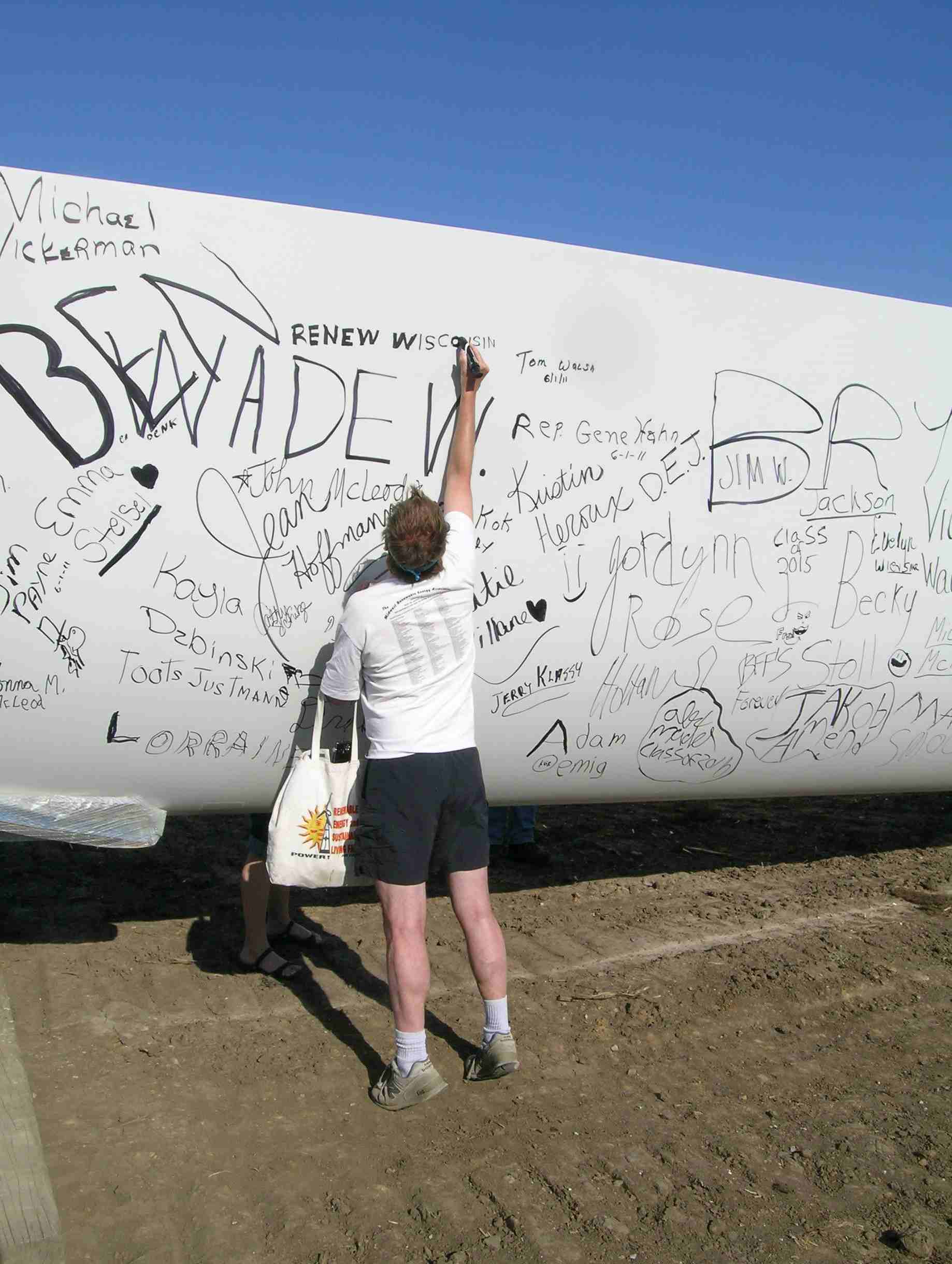
Written on the wind: Glacier Hills open house offers up-close look at project


From an article by Lyn Jerde in the Portage Daily Register:

TOWN OF SCOTT - Along with names, dates and shout-outs to favorite sports teams, the writing on the turbine blade included a warning: "Watch out."

Mark Barden wrote it, in permanent black marker.

The warning, he said, is aimed at any birds that might fly near the blade once it's turning, 400 feet in the air.

Wednesday's open house at the Glacier Hills Wind Park was Barden's first up-close look at the components of the 90 electricity-generating wind turbines that have begun to rise in the skyline in northeast Columbia County.

But it won't be his last look. Barden said three of the towers will be on his land in the town of Scott, just outside of Cambria.

He said he doesn't share the health and safety concerns about the wind towers that many of their opponents cited in seeking to block the construction of Glacier Hills - things such as constant low-level noise and shadow flicker.

"I'm more worried," he said, "about the red lights at night," he said. "When I look in the sky and try to find constellations, all I'll see is the red beacons (on the towers).

"But," Barden added, "we'll deal with that."

Barden was one of several hundred people who attended the open house, which included indoor easel and tabletop displays, and a tour - on foot or by school bus - of one of the four towers that, as of Wednesday, had two of its four segments erected.

Mike Strader, site manager for the We Energies project, said that, barring wind or other inclement weather, plans call for adding the top two segments to at least one of the towers today, with the hub, cell and three blades of the turbine to follow soon.

More photos on RENEW's Facebook page.

Thursday, May 26, 2011

Energy groups oppose bill to undermine Wisconsin's renewable energy commitment

From statements issued by three groups in opposition to Assembly Bill 146:

"Clearly, this bill is a drastic step in the wrong direction for our state. The Wisconsin Energy Business Association therefore opposes this attack on renewable energy in our state." - Wisconsin Energy Business Association. Full statement.

We strongly recommend that this bill not be approved as it solves no known problem in Wisconsin and seeks only to roll-back policies on renewable energy that have served the state well and are otherwise benefitting Wisconsin residents with cleaner air and lower prices for electricity. - Wind on the Wires. Full statement.

Fresh attack on Wisconsin voters’ desire for a renewable energy standard would kill wind projects and sap state’s economy, say wind energy advocates - American Wind Energy Association. Full statement.

Thursday, May 19, 2011

Conservation Voters object to bill that would allow renewable energy to come from Canada

From an article in the Green Bay Press-Gazette:

Wisconsin utilities could count power from a Canadian hydroelectric plant as a renewable source of energy under a bill quickly moving through the Legislature, despite objections from environmental groups.

The bill modifies an existing law that requires 10 percent of the electricity providers sell to come from renewable sources by 2015, but specifies any hydroelectric source must produce less than 60 megawatts of power.

That provision, meant to ensure electric providers would use Wisconsin-based hydroelectric facilities, is rewritten to also allow newly constructed plants in Manitoba, Canada, that produce more than 60 megawatts of power.

The state Senate approved the measure in a 21-11 vote Tuesday afternoon. The bill wouldn’t take effect until Dec. 31, 2015.

“There’s a number of electric companies that want to find ways to meet their 2015-and-beyond mandates, and they want to do it in the most economical manner,” said Sen. Frank Lasee, R-Ledgeview, the bill’s chief sponsor. “The Left has got it wrong on jobs and green energy. We can’t take more from all the businesses and ratepayers in Wisconsin just to foster green energy jobs.”

Conservationists say allowing companies to purchase hydroelectric power from Canada undermines the efforts of Wisconsin’s clean energy industry.

“They’re basically allowing Manitoba power to flood the renewable energy market in Wisconsin,” said Jennifer Giegerich, legislative director for the Wisconsin League of Conservation Voters. “Once this is allowed to be counted, we’re concerned utilities will dump their current contracts and get this cheap energy from Canada. That puts Wisconsin energy jobs at risk.”

Monday, May 16, 2011

We Energies Terminates Its Renewable Energy Program

For immediate release
May 13, 2011
More information
RENEW Wisconsin
Michael Vickerman
608.255.4044
mvickerman@renewwisconsin.org

We Energies Terminates Its Renewable Energy Program
Utility Pulls Plug on $6 Million a Year Commitment

As reported on its Web site, Milwaukee-based We Energies will discontinue an innovative and effective renewable energy development program that supported scores of renewable energy systems throughout its service territory. [The announcement can be accessed at http://www.we-energies.com/re.]

“It’s a sad day when the state’s largest utility decides to walk away from its commitment to a clean energy future,” said Michael Vickerman, executive director of RENEW Wisconsin, a statewide organization advocating for public policies and private initiatives that advance renewable energy.

As indicated in various filings with the Public Service Commission, We Energies had committed to spend $6 million a year over 10 years to increase its renewable energy supplies and make renewable energy more affordable to its customers through grants and incentives. We Energies’ commitment came in the wake of a settlement with RENEW over the utility’s plans to build two coal-fired power stations in southeast Wisconsin.

Of the $60 million committed, the utility has spent approximately $30 million since 2006. This program will be zeroed out in We Energies’ next rate filing, which will cover 2012 and 2013.

This program supported numerous customer-sited renewable energy installations [see list below], conferences and workshops, research and development activities, and innovative buyback rates.

“Perhaps not coincidently, the decision to terminate this program comes just months after We Energies placed its second coal-fired plant in service. The $6 million a year was a small price to pay for the all of the renewable energy advances that occurred while the utility built two coal plants,” said Vickerman.

“Now that the coal plant is up and running, it appears that the program has outlived its usefulness to We Energies,” Vickerman said.
Six million dollars equates to about .025 percent of We Energies’ annual expenditures.

“This cancellation comes as a blow to area contractors and businesses that were relying on the program to create jobs and clean energy,” said Vickerman. “The achievements leveraged far outweigh the program’s negligible cost.”

“Between utility program cutbacks and state government rollbacks, Wisconsin’s policy framework for supporting renewable energy will be largely dismantled by the end of the year.”

--END- -

RENEW Wisconsin is an independent, nonprofit 501(c)(3) organization that acts as a catalyst to advance a sustainable energy future through public policy and private sector initiatives. More information on RENEW’s Web site at www.renewwisconsin.org.
Customer-owned renewable energy success stories and live data

A growing number of customers have their own renewable energy facilities. The links below go to summaries of the projects and/or real-time production data from the solar photovoltaic, solar hot water and wind renewable energy generation systems.

Solar electric photovoltaic
Ascension Lutheran Church
Cedar Community
City of Brookfield Safety Building
Concordia University Wisconsin
Cooper Elementary School
Cross Lutheran Church
Crown of Life Lutheran Church
Energy Producing Home #1
Evangelical and Reformed United Church of Christ - Waukesha
Fairview Charter School
Family Enrichment Center of Ozaukee County
First Congregational Church - Port Washington
First Unitarian Society of Milwaukee
Fox River Christian Church
Fox Valley Lutheran High School
Gateway Technical College Horizon Center Solar Tracker
GE Healthcare
GE Research Park
Good Shepherd Evangelical Lutheran Church and School
Growing Power - Milwaukee
HOPE Christian School
Johnson Foundation
Kettle Moraine Lutheran High School
La Casa de Esperanza
Lake Country School
Lake Park Lutheran Church
Lawrence University
Madison Area Technical College - Fort Atkinson Campus
Madison College - Fort Atkinson
Menomonee Falls North Middle School
Milwaukee Area Tech College - Oak Creek
Milwaukee Central Library
Milwaukee County Zoo
Milwaukee Metropolitan Sewerage District
Milwaukee Recycling Education Facility
MSOE:Fat Spaniel Tech MSOE Monitor
Navarino Nature Center
North Shore Presbyterian Church
Our Savior Lutheran Church
Outpost Natural Foods
Pragmatic Construction Home 1 - PV
Purdy Elementary School - Fort Atkinson
Racine City Hall Annex
Racine Eco-Justice Center
Racine St. Catherine's High School
Schlitz Audubon Nature Center
St. Matthew’s Evangelical Lutheran Church
Shoreland Lutheran High School
Shorewood School District
Still Point Zen Center
The Order of Julian of Norwich
Town of Greenville
Town of Menasha
Unitarian Universalist Church West
United Community Center
University of Wisconsin - Milwaukee
University of Wisconsin - Parkside
Urban Ecology Center
Village of Marshall Wastewater Treatment Facility
Village of Wind Point
Walden III Middle and Senior High School
Waukesha County Technical College
Wauwatosa Fire Department
Whitewater Innovation Center
Wisconsin Lutheran College
Wisconsin State Fair Park

Solar water heating
Fort Atkinson High School Solar Thermal
Fort Atkinson Middle School Solar Thermal
Milwaukee Habitat for Humanity SHW 1
Milwaukee Habitat for Humanity SHW 2
We Energies HQ: Fat Spaniel Tech Wired Solar

Solar electric photovoltaic and wind
Discovery World
Lakeshore Technical College
Mequon Nature Preserve
Milwaukee Area Tech College - Mequon

Wind
Boys & Girls Club of Greater Milwaukee – Camp Whitcomb Mason
Village of Cascade Wastewater Treatment Plant

List from We Energies' Web site -- http://www.we-energies.com/residential/energyeff/active_installdata.htm

Friday, May 6, 2011

Third large Wisconsin wind project cancelled due to legislative blockage

From an article by Tom Content in the Milwaukee Journal Sentinel:

Moves to restrict wind farm development in Wisconsin led a Madison utility to take a $5 million charge, citing the difficulty of being able to build the project in Green Lake and Fond du Lac counties.

“Events arising in the first quarter of 2011 lead us to conclude it would be difficult to effectively use the

site for wind development,” said Bill Harvey, Alliant chairman and chief executive, during an investor conference call.

Alliant Energy Corp. had bought development rights to the project several years ago from NextEra Energy Resources, at a time the state was looking to increase its renewable energy targets.

The $5 million charge is in recognition of the fact that it will be much more difficult to build the wind farm given uncertainty in the state’s wind siting requirements, said utility spokesman Steve Schultz.

During his first month in office, Gov. Scott Walker announced a property rights bill that aimed to restrict wind farm development to move turbines farther away from nearby properties. Local groups that have challenged wind farms supported the move, but wind energy developers said it would make it tough to build wind farms in the state.

Walker’s bill is on hold, and the Legislature has moved to suspend a statewide siting standard that the wind developers had said they could live with.

As a result, no statewide standard currently exists, and the Legislature and Public Service Commission are continuing to discuss how to address wind standards.

Uncertainty in the state’s wind siting rules led two developers to cancel wind farm development in the state earlier this year.

Wednesday, May 4, 2011

Budget commitee slashes energy efficiency funding

From an article by Mike Ivey in The Capital Times:

Cuts to key environmental programs continue in Wisconsin, with a sharp reduction in future funding for Focus on Energy, a statewide energy efficiency effort.

On a party-line vote Tuesday, the Legislature's Joint Finance Committee rolled back the budget for Focus on Energy to less than $100 million annually. The monies come from a tax on electric utility revenues and are distributed to businesses and individuals for energy savings projects.

The Focus on Energy program has been administered over the past years by the Wisconsin Energy Conservation Corp., a Madison-based non-profit. But the contract was awarded earlier this year to the Shaw Group, a Baton Rouge, La., firm with offices in Milwaukee.

The Public Service Commission in November 2010 had proposed new energy savings goals for Focus on Energy by hiking the utility assessment. Those budgets were then approved by the Democratic majority in Joint Finance and would have upped money in the program from $120 million in 2011 to $256 million by 2014.

But with the committee action, funding for Focus on Energy will remain flat for the foreseeable future.

Co-chairman Rep. Robin Vos, R-Rochester, led opposition to the increase, calling it a redistribution of utility ratepayer dollars.

Launched in 2001, Focus on Energy has helped residents and businesses save nearly $2 billion on their energy bills, supporters of the program say.

Tuesday, April 26, 2011

GE Healthcare seeks OK for wind turbines

From an article by Laurel Walker in the Milwaukee journal Sentinel:

Waukesha - GE Healthcare is seeking city permission to install 10 wind turbines up to 155 feet tall on its 662-acre Waukesha campus on county Highway T north of I-94.

The project, if approved, would be built next year or later, said Annette Busateri, public relations manager. It is part of the company's 2015 goal of reducing electrical usage by 15% and improving building energy efficiency by at least 10%, she said.

The Waukesha Plan Commission is scheduled to consider a conditional use permit for the project at its 6 p.m. meeting Wednesday. The city has no wind turbines, planner Michael Hoeft said.

City planner Jennifer Andrews said the company has lined up letters indicating state and federal agencies likely have no objections.

"They seem to have all their ducks in a row," she said.

Although the proposed turbines are about a mile from the runways of Waukesha County's airport, Crites Field, their height would be below the limit set by the county's zoning ordinance that protects airspace around the airport from encroaching structures.

The plan calls for turbines on towers ranging from 135 to 155 feet tall. Three would be behind the former headquarters building, now an assembly building for medical imaging equipment that's the farthest north of three buildings. The other seven would be between the two other buildings farther south.

Waukesha County Parks and Land Use Director Dale Shaver said there are no commercial wind turbines in the county. Not only would this project be the first, but they would be near a high-traffic, very visible interchange.

Monday, April 25, 2011

Learn about a Transition Initiative in your community, April 28

Join or start a Transition Initiative in your community

“The Transition Movement is a vibrant, grassroots movement that seeks to build community resilience in the face of such challenges as peak oil, climate change and the economic crisis. It represents one of the most promising ways of engaging people in strengthening their communities against the effects of these challenges, resulting in a life that is more abundant, fulfilling, equitable and socially connected.”

Find a transition group near you: http://transitionus.org/about-us

Join us for a presentation:
Transitions
by Eric Lindberg from Transitions ~ Milwaukee

Time: Thursday, April 28 • 5:30pm - 8:30pm
Location: House of Tawet, Coffee house
601 N. Broadway
Green Bay, WI
________________________________________
Created By Helfenstein Soup Council, inc., Kim Diaz
________________________________________
More Info HOT Stone Soup Evenings Presents: Eric Lindberg from Transitions Milwaukee speaking on the Transitions movement of building sustainable communities with local Resilience, Self-Reliance, Renewable Energy & Cooperation.

http://www.amazon.com/Transition-Handbook-Dependency-Resilience-Guides/dp/1900322188#reader_1900322188

Friday, April 22, 2011

Poll finds strong support for wind energy in Wisconsin

From an article in the Chicago Tribune:

MADISON, Wis.— A poll of Wisconsin residents finds strong support for increasing the use of wind energy, even if doing so would raise electricity bills several dollars per month.

The Wisconsin Public Radio poll was released Friday. It shows that 77 percent of respondents want to see the state invest more in wind energy. Reasons included decreasing the nation's reliance on foreign oil and helping the environment.

A majority, 69 percent, wouldn't mind eight to 10 wind-energy machines being placed closed to where they live, and 79 percent favor placing the machines offshore in Lake Michigan.

Click here for poll results.