
The Public Service Commission of Wisconsin issued its final order on construction of We Energies' Glacier Hills Wind Park. The order included, among others, several provisions to allow residences to seek remedies should they feel bothered by turbines in the project (numbering follows the numbering in the written PSC order, pages 48-54):
10. WEPCO shall operate the project in a manner that meets noise limits of 50 dBA during daytime hours, and, upon complaint by an affected resident, shall be permanently reduced to 45 dBA during nighttime hours for areas related to the complaint. Nighttime hours are defined to include those hours between 10:OO p.m. to 6:00 a.m. daily, from April 1 through September 30. The requirement to meet the seasonally reduced nighttime noise limit shall be triggered by the receipt by WEPCO of any complaint regarding nighttime noise levels. Methods available for WEPCO to comply with both the daytime and nighttime noise limits shall include, but are not limited to, operational curtailment of the turbine or turbines contributing to the exceedance of the noise limits. WEPCO is relieved from meeting the nighttime noise limit if the affected resident agrees to a financial settlement. Compliance with noise limits shall be measured or otherwise evaluated at the outside wall of the non-participating residence. WEPCO
shall provide notification to potentially affected residents of the provisions of this Final Decision relating to noise limits prior to initial operation of the project.
11. WEPCO shall evaluate compliance with the noise limits included in this Final Decision as part of its post-construction noise study. The post-construction noise study shall be conducted as described in the most current version of the PSC Noise Measurement Protocol. WEPCO shall file a copy of the post-construction noise study report with the Commission.
12. WEPCO shall construct its project using a minimum setback from non-participating residences of 1,250 feet.
15. WEPCO shall work with local electric distribution companies to test for stray voltage at all dairy operations within one-half mile of any project facility, prior to construction and again after the project is completed. WEPCO shall work with the distribution utilities and farm owners to rectify any stray voltage problems arising from the construction and operation of the project. Prior to any testing, WEPCO shall work with Commission staff to determine the manner in which stray voltage measurements will be conducted and on which properties. WEPCO shall provide to Commission staff reports of the results of stray voltage testing.
16. WEPCO shall work with landowners to mitigate the effects of shadow flicker. WEPCO shall provide shadow flicker mitigation for residences experiencing 25 hours per year or more of shadow flicker. Residences shall be eligible for mitigation if computer modeling shows that shadow flicker would exceed 25 hours per year, and the property owner need not document the actual hours per year of shadow flicker to be eligible. Residences that exceed 25 hours per year of shadow flicker based on logs kept by the resident shall also be eligible for mitigation. The requirement to mitigate shadow flicker at eligible residences shall be triggered by the receipt by WEPCO of a complaint regarding shadow flicker. WEPCO shall allow the resident to choose a preferred reasonable mitigation technique, including but not limited to, installation at WEPCO's expense of blinds or planting. WEPCO shall provide notification to potentially affected residents of the provisions of this Final Decision relating to shadow flicker prior to initial operation of the project. WEPCO may provide shadow flicker mitigation for residences experiencing less than 25 hours per year of shadow flicker.
17. WEPCO shall maintain a log of all complaints received regarding the project. The log shall include, at a minimum, the name and address of the complainants, nature of the complaints, and steps taken by WEPCO to resolve the complaints. WEPCO shall make copies of this complaint log available, at no cost, to the monitoring committees authorized by the town of Randolph and town of Scott JDAs.
18. WEPCO shall coordinate with local first responders and air ambulance services regarding the development of an emergency evacuation plan, including the locations of alternate landing zones. The plan shall include provisions for public inspection of the plan, as appropriate. WEPCO shall file the final plan with the Commission, using the Commission's confidential filing procedures, if necessary.
19. WEPCO shall follow the provisions of the town of Scott and town of Randolph JDAs regarding radio and television interference. In addition, WEPCO shall consult with affected residents regarding the residents' preferred reasonable mitigation solution for radio and television interference problems, prior to implementing remedial measures, and that the preferred solution shall be made permanent.
20. WEPCO shall follow the provisions of the town of Scott and town of Randolph JDAs regarding cellular communications interference. In addition, WEPCO shall work with affected cellular providers to provide adequate coverage in the affected area. Mitigation techniques for lost or weakened cellular telephone communications shall include, but are not limited to, an additional micro-cell, cell, or base station facility to fill in the affected area. The micro-cell, cell, or base station may be installed on one of the structures within the wind energy facility.
21. WEPCO shall develop and file a plan with the Commission, for Commission approval prior to construction, to reduce the individual hardships to the Smitses and Regneruses. The plan shall be developed in consultation with these two families. The plan may include, but is not limited to: relocation of turbines to reduce the number of turbines within one-half mile to no more than seven turbines; providing annual payments to these two families, not to exceed the amount paid to participating residents receiving payment for one turbine lease; or, purchasing the properties at fair market value.
22. Compliance with setback provisions for non-participating residences shall be measured from the centerline of the turbine tower to the nearest point on the foundation of the residence.
25. WEPCO shall provide up to $150,000 of funding towards an operational curtailment and bat mortality study at GHWP, or a site with similar characteristics, as determined by Commission staff. These funds may be applied to a study effort undertaken by another entity or, if no other study can be identified, WEPCO shall develop and coordinate a study and shall seek additional funding from other entities.
26. WEPCO shall provide proposed designs of the required bat and bird studies to DNR and Commission staff for review, and Commission staff shall approve the final study design.
Showing posts sorted by relevance for query noise. Sort by date Show all posts
Showing posts sorted by relevance for query noise. Sort by date Show all posts
Monday, January 25, 2010


Friday, February 15, 2013
Wind farm proposal rejected, developer plans another try
More on the Highland Wind Farm PSC decision: an article by Thomas Content of the Journal Sentinel:
State regulators on Thursday rejected an application to build a new wind farm in St. Croix County, citing concerns about turbine noise the project would generate for nearby homes.
The state Public Service Commission voted 2-to-1 to reject Emerging Energies’ proposal to build the Highland wind farm, which was proposed to generate 102.5 megawatts of power from 41 turbines, or eough to supply about 30,000 homes.
Commissioners said that they were rejecting the proposal “without prejudice,” in essence leaving the door open for the developer to file a new application for the project, after it conducts a new noise study using more conservative assumptions about the background noise in the area.
The $250 million Highland project is the first wind farm to be ruled on by the state commission since Republican Gov. Scott Walker appointed two commissioners, a majority of the three-member panel.
Emerging Energies representative Jay Mundinger said after the vote the developer plans to continue its pursuit of a permit for the project.
Commissioner Eric Callisto, the lone remaining appointee of former Democratic Gov. Jim Doyle, said he would have approved the project but would have attached conditions binding the developer to protect nearby landowners from excessive turbine noise.
Noise studies by the applicant found that 20 homes would experience noise levels above the 45 decibel standard at night, but the commission could work with the developer on "micro-siting" issues after new analysis was done, he said.
The Highland project is the only large wind energy project currently in active development in the state. The state’s utilities have already built enough wind farms to comply with the Wisconsin renewable portfolio standard, which requires that 10% of the state’s electricity come from renewable sources by 2015.
During the commission’s meeting in Madison, commissioner Ellen Nowak said the applicant didn’t prove that all the wind project would result in noise levels below 45 decibels at night, the standard that’s in Wisconsin’s wind siting rule.
As a result, she said she concluded the project was not in the public interest.
In their decision, the PSC commissioners decided not to attach special requirements concerning low-frequency noise, after wind consultants studied the impacts of low frequency noise from wind turbines the same developer built near Green Bay.
Reached after the meeting, Mundinger said Emerging Energies would take the commissioners' noise concerns into account but was not giving up on the project.
“We believe that sound, from what we’ve heard, is a big concern, and we believe we can address that and we believe we have a pathway to get the (project permit) in short form,” he said. "We want to make sure we address the sound and be able to move this project forward.”
The company has offered not to use the kind of turbine that it used when developing the Brown County wind farm -- the tallest towers built so far in Wisconsin. Instead, Emerging Emergies has agreed to use two other turbines that don’t generate as much sound, he said.
PSC commissioners said they would not approve the project if it used the loudest of the three turbines Emerging Energies had been considering.
“The turbines are better than ever before,” Mundinger said. “They’re quieter than the ones just 10 years ago.”
Peter McKeever, attorney for the Forest Voice, a group that mobilized in opposition to the wind farm,said he was pleased with the commission’s decision.
Wind farms are difficult to build in Wisconsin because the state’s dairy farming heritage and land use history resulted in smaller farms being closer together rather than large farms that are farther apart on the Great Plains, he said.
“If we want wind to be a really viable energy source we have to get smart about siting wind farms in Wisconsin,” he said.
The state should be leery of developing projects where homeowners could experience problems similar to those found in the Green Bay area project, McKeever said.
At issue in this case is one of the variables in that model – an estimate of how much sound would be absorbed by the ground when the wind turbines are spinning.
In this case, the commission essentially asked Emerging Energies to assume a worst-case scenario: That the 45-decibel standard will be met at all times, even when there is totally reflective ground – hard frozen ground with no snow or vegetation on it.
The commission adopted a more stringent noise requirement than it did when it approved its most recent wind farm, the We Energies Glacier Hills Wind Park, in 2010, said Katie Nekola, general counsel at the conservation group Clean Wisconsin. However, in that case, there was no challenge to the assumptions used by We Energies in its turbine noise modeling.
She expressed hope that the decision would be a temporary setback for the Highland project.
See the original posting of this article here.
Friday, October 23, 2009
Experts rip anti-wind arguments
Even though the quotes below from pre-filed statements take the form of rebuttal testimony in the PSC proceedings on We Energies Glacier Hills Wind Park, they can stand on their own. You need not read the filings they rebut in order to make sense out of what they're saying.
The pre-filed testimony stands among the strongest redupiation of anti-wind arguments.
These filings will be formally entered into the record when the technical hearings begin on November 2nd, but they (and all other filings) are available online at the Web site of the Public Service Commission and link directlyi to case 6630-CE-302.
Richard Larkin, a state certified real estate appraiser, rebuts a “study” of property values paid for by the Coaliton for Wisconsin Environmental Stewardship (CWESt), a group opposing the Glacier Hills project:
William Roberts, PhD in Epidemiology, former faculty member with the Medical College of Wisconsin (Dept. of Preventative Medicine), former Oklahoma State Epidemiologist dissects Dr. Nina Pierpont's "research" and rebuts CWESt's acoustical consultant. He summarized his testimony as follows:
Geoff Leventhall, acoustical consultant, PhD in acoustics, presented testimony to rebut CWESt's acoustical consultant.
The pre-filed testimony stands among the strongest redupiation of anti-wind arguments.
These filings will be formally entered into the record when the technical hearings begin on November 2nd, but they (and all other filings) are available online at the Web site of the Public Service Commission and link directlyi to case 6630-CE-302.
Richard Larkin, a state certified real estate appraiser, rebuts a “study” of property values paid for by the Coaliton for Wisconsin Environmental Stewardship (CWESt), a group opposing the Glacier Hills project:
I am responding to testimony submitted by Kurt Kielisch on behalf of CWESt, in 1 which he claims that paired sales analyses at the Blue Sky Green Field and Forward wind projects shows that proximity to wind turbines results in a significant negative impact on residential real estate values. There are significant (and probably fatal) problems with his analysis, which I will explain in my testimony. . . .Read all of Larkin’s testimony here.
. . .it is my opinion that Appraisal One’s Wind Turbine Impact Study is significantly flawed, and in my opinion, likely meaningless.
William Roberts, PhD in Epidemiology, former faculty member with the Medical College of Wisconsin (Dept. of Preventative Medicine), former Oklahoma State Epidemiologist dissects Dr. Nina Pierpont's "research" and rebuts CWESt's acoustical consultant. He summarized his testimony as follows:
+ “Wind Turbine Syndrome” is not a medical diagnosis supported by peer reviewed, published, scientific literature;Read all of Roberts’ testimony here.
+ The materials presented to support “Wind Turbine Syndrome” are not of sufficient scientific quality nor have they received the rigorous scientific review and vetting that is customarily part of the peer review and publishing process;
+ The tried and true scientific method of developing a hypothesis, testing that hypothesis, publishing the results and having others attempt to repeat the research has not been done to test the existence of a health condition called “Wind Turbine Syndrome;”
+ An accumulation of anecdotal interviews with self-selected persons living near a wind turbine does not constitute an epidemiological study and is not sufficient to determine causation;
+ The bases for claimed adverse health effects due to wind turbines cited by Mr. James either cannot withstand scientific scrutiny or have nothing to do with wind turbines; and
+ Siting a wind turbine within view of a residence and the operation of that turbine could be a source of annoyance to those living in the residence.
Geoff Leventhall, acoustical consultant, PhD in acoustics, presented testimony to rebut CWESt's acoustical consultant.
Based on my experience of infrasound and low frequency noise, it is my belief that the infrasound from wind turbines is of no consequence. Attempts to claim that illnesses result from inaudible wind turbine noise do not stand up to simple analyses of the very low forces and pressures produced by the sound from wind turbines. Additionally, the body is full of sound and vibration at infrasonic and low frequencies, originating in natural body processes. As an example, the beating heart is an obvious source of infrasound within the body. Other sources of background low frequency noise and vibration are blood flows, muscle vibrations, breathing, fluids in the gut and so on. The result is that any effect from wind turbine noise, or any other low level of noise, which might be produced within the body is “lost” in the existing background noise and vibration. This is considered in more detail in my Appraisal of Wind Turbine Syndrome, which is submitted as Exhibit 18.Read all of Leventhall’s testimony here.
More broadly, my testimony establishes that the claims of health effects from the low levels of infrasound and low frequency noise from wind turbines, as described in the Wind Turbine Syndrome and Vibroacoustic Disease hypotheses, fail. However, higher frequency noise from wind turbines, if it is audible, can cause disturbance to some residents, but this effect is no different from that of noise from another source.
Thursday, October 30, 2008
Study says Blue Sky Green Field turbines meet all established noise limits

From the "Post Construction Noise Survey Report" by Hessler Associates, Inc.
Principal Consultant: George F. Hessler Jr.
Report Number 061608-1
The following text is taken from pages 5 and 6 of the 34-page report.
The complete report is public record and available on this PSC website link:
http://psc.wi.gov/apps/erf_share/view/viewdoc.aspx?docid=102715
“The test engineers did not observe any adverse character or tones from the wind turbines at the measurement locations near residences. The author did not witness any often described ‘whoosh-whoosh’ character except when very close (50 ft) from a turbine. The whoosh-whoosh is observed when each blade visually passes the 9:00 o’clock position.
It is clear from the plots that the Blue Sky Green Field wind turbines do not generate significant LFN.” (low frequency noise)
3.0 Conclusions
Based on the presented data and analysis, we conclude that the BSGF wind turbine project meets all established noise limits and design goal for the project. Health effects in the form of sleep interference and low frequency noise level issues are addressed and it is concluded there should not be adverse response caused by these issues. Annoyance to low-level, but audible noise is not predictable and may depend on non-technical factors in addition to measured sound levels.”
Report Prepared by:
Hessler and Associates, Inc.
Consultants in Engineering Acoustics
3862 Clifton Manor Place Suite B
Haymarket, VA 20169
www.hesslernoise.com
Tuesday, October 13, 2009
Excerpts from the Glacier Hills Wind Park EIS
The Public Service Commission issued the final environmental impact statement on the Glacier Hills Wind Park, and it includes these items:
Medical Impacts (page 68)
UW Med Flight is the responding air ambulance service closest to the Glacier Hills project area. UW Med Flight and the other reswponding agencies plan to develop safe landing sites or locations within the project area to which medical helicopters could be dispatched. Establishing alternative landing zones in an area is a common tool employed by medical helicopter services where terrain, vegetation, or
structures restrict landing sites....
In some instances, alternate landing sites may not be required; a medical helicopter can land in proximity to a wind turbine if it is safe and prudent to do so. There do not seem to be any UW Med Flight rulers or policies that would preclude landing within a project area if it is safe to do so. The decision about where to land is the pilot's and is based on a variety of site factcors that present themselves upon arrival at an emergency scene. For example, closer landins to a turbine might be possible if the winds are calm and the wind turbine rotors are not rotating.
Sound Impacts (Page 82)
The studies done to date suggest that there is a wide variability in how peopole react to wind turbine noise and that many people do no appear to be affected. The studies do, however, support the concern that some people do react negatively to wind turbine noise, primarily through annoyance and sleep disturbance. It is widely accepted that disruption of sleep can lead to other physiological and psychological problems.
Dr. Nina Pierpont has hypothesized that in addition to annoyance and disturbance, wind turbine noise can result in direct activation of the vestibular and autonomic system leading to other health problems. The validity of this suggestion has been questioned. The Minnesota Department of Health concluded that "evidence is scant" for this hypothesis.
In summary, it is important to recognize that turbine noise can be problematic for some people. Although specific sound levels or distances from turbines cannot be directly correlated with these disturbance or annoyance problems, project design and siting should take potential impactcs of turbine noise into account.
Property Values (page 84)
A more recent study of two recently completed Wisconsin wind farms was completed by Appraisal Group One. This study contained similar problems of small sample size and weak statistical analyses. While the study was limited to residential vacany land sales, other potential factors that might influence sales prices were not analyzed. The study did not verify that all properties sold within the wind farm areas actually had views of wind turbines, whether the properties were sold prior to the proposal of a wind facility versus after the facilities were constructed and operating, and it did not differentiate between vacant lots with infrastructure potential such as streets, sewer, and water as opposed to farmland with no infrastructure.
Medical Impacts (page 68)
UW Med Flight is the responding air ambulance service closest to the Glacier Hills project area. UW Med Flight and the other reswponding agencies plan to develop safe landing sites or locations within the project area to which medical helicopters could be dispatched. Establishing alternative landing zones in an area is a common tool employed by medical helicopter services where terrain, vegetation, or
structures restrict landing sites....
In some instances, alternate landing sites may not be required; a medical helicopter can land in proximity to a wind turbine if it is safe and prudent to do so. There do not seem to be any UW Med Flight rulers or policies that would preclude landing within a project area if it is safe to do so. The decision about where to land is the pilot's and is based on a variety of site factcors that present themselves upon arrival at an emergency scene. For example, closer landins to a turbine might be possible if the winds are calm and the wind turbine rotors are not rotating.
Sound Impacts (Page 82)
The studies done to date suggest that there is a wide variability in how peopole react to wind turbine noise and that many people do no appear to be affected. The studies do, however, support the concern that some people do react negatively to wind turbine noise, primarily through annoyance and sleep disturbance. It is widely accepted that disruption of sleep can lead to other physiological and psychological problems.
Dr. Nina Pierpont has hypothesized that in addition to annoyance and disturbance, wind turbine noise can result in direct activation of the vestibular and autonomic system leading to other health problems. The validity of this suggestion has been questioned. The Minnesota Department of Health concluded that "evidence is scant" for this hypothesis.
In summary, it is important to recognize that turbine noise can be problematic for some people. Although specific sound levels or distances from turbines cannot be directly correlated with these disturbance or annoyance problems, project design and siting should take potential impactcs of turbine noise into account.
Property Values (page 84)
A more recent study of two recently completed Wisconsin wind farms was completed by Appraisal Group One. This study contained similar problems of small sample size and weak statistical analyses. While the study was limited to residential vacany land sales, other potential factors that might influence sales prices were not analyzed. The study did not verify that all properties sold within the wind farm areas actually had views of wind turbines, whether the properties were sold prior to the proposal of a wind facility versus after the facilities were constructed and operating, and it did not differentiate between vacant lots with infrastructure potential such as streets, sewer, and water as opposed to farmland with no infrastructure.
Wednesday, December 17, 2008
Forward Wind sound levels below projections
Like an earlier sound study on Blue Sky Green Field, a September study on sound levels at the Forward Wind Energy Center found positive results, as reported to the Public Service Commission:
Forward Energy LLC owns and operates the Forward Wind Energy Center (FWEC), a nominal 129-megawatt power generation facility consisting of eighty-six (86) General Electric Model 1.5sle wind turbines located in Dodge and Fond du Lac Counties, Wisconsin. As stipulated by the Wisconsin Public Service Commission (WPSC) in their Final Decision for the project, (Docket No. 9300-CE-100, July 14, 2005) FWEC is required to measure post-construction noise levels within three months of commencing commercial operations. In May 2008, Michael Theriault Acoustics, Inc. (MTA) was retained by Forward Energy to perform these tests.
Noise tests were conducted in accordance with the WPSC’s "Measurement Protocol for Sound and Vibration Assessment of Proposed and Existing Electric Power Plants,” as modified by the Commission for wind turbine power projects. This report summarizes the test results and concludes that noise levels produced by the Facility, as well as noise impacts potentially generated during operations, were generally lower than originally presented in the project’s Certificate for Public Convenience and Necessity (CPCN) Application.
Forward Energy LLC owns and operates the Forward Wind Energy Center (FWEC), a nominal 129-megawatt power generation facility consisting of eighty-six (86) General Electric Model 1.5sle wind turbines located in Dodge and Fond du Lac Counties, Wisconsin. As stipulated by the Wisconsin Public Service Commission (WPSC) in their Final Decision for the project, (Docket No. 9300-CE-100, July 14, 2005) FWEC is required to measure post-construction noise levels within three months of commencing commercial operations. In May 2008, Michael Theriault Acoustics, Inc. (MTA) was retained by Forward Energy to perform these tests.
Noise tests were conducted in accordance with the WPSC’s "Measurement Protocol for Sound and Vibration Assessment of Proposed and Existing Electric Power Plants,” as modified by the Commission for wind turbine power projects. This report summarizes the test results and concludes that noise levels produced by the Facility, as well as noise impacts potentially generated during operations, were generally lower than originally presented in the project’s Certificate for Public Convenience and Necessity (CPCN) Application.
Friday, September 30, 2011
Study: Little, if any, scientific basis for claims of health threats from wind turbines
From an article Ken Paulman on Midwest Energy News:
There’s no denying that wind turbines make noise. A giant rotor blade the size of an aircraft wing swooshing through the air is going to make a noticeable sound, particularly in a quiet, rural setting.
And it’s an often-repeated claim of wind farm opponents that this noise can lead to a whole host of health issues, including headaches, tinnitus, fatigue and sleep disturbances. Health fears, among other objections, have sometimes been cited by local governments as they establish large setbacks, moratoriums or other restrictions on wind farm development.
But a new study published in the journal Environmental Research Letters (PDF) suggests those claims are, at best, conflated. The analysis by four Swedish scientists reviews existing literature and finds that with the exception of some self-reported cases of sleep disturbance, there is no scientific or empirical basis to conclude that wind turbine noise causes health problems.
Among the works examined was Nina Pierpont’s oft-cited book Wind Turbine Syndrome, which relies on anecdotal evidence from 38 individuals living near wind farms, several of whom reported insomnia, tinnitus, nausea, dizziness and other symptoms. Pierpont concludes that the symptoms are a direct result of low-frequency noise from nearby turbines, but the Swedish researchers found the book “has several limitiations” which “make the conclusion unjustified.”
There’s no denying that wind turbines make noise. A giant rotor blade the size of an aircraft wing swooshing through the air is going to make a noticeable sound, particularly in a quiet, rural setting.
And it’s an often-repeated claim of wind farm opponents that this noise can lead to a whole host of health issues, including headaches, tinnitus, fatigue and sleep disturbances. Health fears, among other objections, have sometimes been cited by local governments as they establish large setbacks, moratoriums or other restrictions on wind farm development.
But a new study published in the journal Environmental Research Letters (PDF) suggests those claims are, at best, conflated. The analysis by four Swedish scientists reviews existing literature and finds that with the exception of some self-reported cases of sleep disturbance, there is no scientific or empirical basis to conclude that wind turbine noise causes health problems.
Among the works examined was Nina Pierpont’s oft-cited book Wind Turbine Syndrome, which relies on anecdotal evidence from 38 individuals living near wind farms, several of whom reported insomnia, tinnitus, nausea, dizziness and other symptoms. Pierpont concludes that the symptoms are a direct result of low-frequency noise from nearby turbines, but the Swedish researchers found the book “has several limitiations” which “make the conclusion unjustified.”
For example, the lack of acoustic measurements, no comparison group of people with no or low wind exposure and no investigation of the subjects prior to the wind turbines were constructed (prior health status was estimated retrospectively). In addition, the results, which are based on a very small sample, are contradicted by results from cross-sectional studies … which included a total of more than 1600 people.
Wednesday, May 26, 2010
UW doctor: No evidence that wind turbines cause health problems
From a presentation to the Public Service Commission Wind Siting Council by Jevon D. McFadden, MD, MPH:
General Conclusions
Evidence does not support the conclusion that wind turbines cause or are associated with adverse health outcomes
Gaps remain in our knowledge of the impact that wind energy may have on human health
Potential positive and potential negative impacts
Passionate analyses, whether by proponents or opponents of wind energy development, may be subject to significant bias, which compromises credibility
Recommendations
Encourage concerned individuals to report symptoms or illness to a healthcare provider
Encourage health officials to continue to assess new evidence as it becomes available
Recommend involving affected individuals in siting process
Shadow Flicker
Wind turbine rotor frequencies
+Average 0.6–1.0 Hz
+Max 3 Hz (at 60 rpm)
+National Research Council: “Harmless to humans”
Photosensitivity epilepsy
+1/4,000 individuals
+Sunlight, TV are common precipitants
Flickeringlight most likely to trigger seizures
+5–30 Hz
Noise & Health —Conclusions
Chronic exposure to high levels of sound
+Hearing loss
+Altered physiological processes
Long-term health effects of chronic exposure to low level sound not well characterized
Noise sensitivity is important determinate of responses to noise
Response to moderate levels of sound affected by cognitive appraisal of sound source
Dr. McFadden lists the following affiliations at the beginning of his presentation:
Centers for Disease Control and Prevention —Epidemic Intelligence Service Officer
United States Public Health Service —Lieutenant Commander
Wisconsin Department of Health Services, Division of Public Health, Bureau of Environmental and Occupational Health
University of Wisconsin, School of Medicine and Public Health, Department of Population Health Sciences —Adjunct Assistant Professor
General Conclusions
Evidence does not support the conclusion that wind turbines cause or are associated with adverse health outcomes
Gaps remain in our knowledge of the impact that wind energy may have on human health
Potential positive and potential negative impacts
Passionate analyses, whether by proponents or opponents of wind energy development, may be subject to significant bias, which compromises credibility
Recommendations
Encourage concerned individuals to report symptoms or illness to a healthcare provider
Encourage health officials to continue to assess new evidence as it becomes available
Recommend involving affected individuals in siting process
Shadow Flicker
Wind turbine rotor frequencies
+Average 0.6–1.0 Hz
+Max 3 Hz (at 60 rpm)
+National Research Council: “Harmless to humans”
Photosensitivity epilepsy
+1/4,000 individuals
+Sunlight, TV are common precipitants
Flickeringlight most likely to trigger seizures
+5–30 Hz
Noise & Health —Conclusions
Chronic exposure to high levels of sound
+Hearing loss
+Altered physiological processes
Long-term health effects of chronic exposure to low level sound not well characterized
Noise sensitivity is important determinate of responses to noise
Response to moderate levels of sound affected by cognitive appraisal of sound source
Dr. McFadden lists the following affiliations at the beginning of his presentation:
Centers for Disease Control and Prevention —Epidemic Intelligence Service Officer
United States Public Health Service —Lieutenant Commander
Wisconsin Department of Health Services, Division of Public Health, Bureau of Environmental and Occupational Health
University of Wisconsin, School of Medicine and Public Health, Department of Population Health Sciences —Adjunct Assistant Professor
Wednesday, June 17, 2009
Two Rivers approves ordinance on small wind-energy systems
From an article by Cindy Hodgson in the Manitowoc Herald Times Reporter:
TWO RIVERS — After a public hearing at which only one person spoke, the Two Rivers City Council on Monday evening approved a new ordinance regulating small wind energy systems. The vote was 8-0 with Mark Matthews absent, according to City Manager Greg Buckley.
The ordinance repeals and replaces a previous wind-energy ordinance. It specifically addresses small wind-energy systems, which are those used primarily to provide power for the property on which they are located and that have a rated capacity of no more than 100 kilowatts per turbine generator.
One provision of the new ordinance is that it allows people to purchase noise easements. Essentially, if their wind turbine is making more noise than the ordinance allows, they can negotiate with their neighbors to buy the right for their turbines to produce the additional noise, according to Buckley.
Small wind-energy systems may be permitted, with a conditional use permit, in industrial, conservancy or institutional/ public facilities districts. They may not be taller than 170 feet and they must be set back a distance of at least 110 percent of their total height from property lines, road rights-of-way and communication and electrical lines.
"This ordinance is meant to encourage the use of such wind turbines, while maintaining reasonable protections for nearby property owners," Buckley said via e-mail.
The Plan Commission will discuss large-scale, commercial wind turbines at its July meeting, according to Buckley.
TWO RIVERS — After a public hearing at which only one person spoke, the Two Rivers City Council on Monday evening approved a new ordinance regulating small wind energy systems. The vote was 8-0 with Mark Matthews absent, according to City Manager Greg Buckley.
The ordinance repeals and replaces a previous wind-energy ordinance. It specifically addresses small wind-energy systems, which are those used primarily to provide power for the property on which they are located and that have a rated capacity of no more than 100 kilowatts per turbine generator.
One provision of the new ordinance is that it allows people to purchase noise easements. Essentially, if their wind turbine is making more noise than the ordinance allows, they can negotiate with their neighbors to buy the right for their turbines to produce the additional noise, according to Buckley.
Small wind-energy systems may be permitted, with a conditional use permit, in industrial, conservancy or institutional/ public facilities districts. They may not be taller than 170 feet and they must be set back a distance of at least 110 percent of their total height from property lines, road rights-of-way and communication and electrical lines.
"This ordinance is meant to encourage the use of such wind turbines, while maintaining reasonable protections for nearby property owners," Buckley said via e-mail.
The Plan Commission will discuss large-scale, commercial wind turbines at its July meeting, according to Buckley.
Wednesday, August 24, 2011
County board in Iowa OKs wind farm ordinance with 1,000-foot setback
From an article by Rob Daniel in the Iowa City Press-Citizen:
Johnson County is a step closer to having its own wind farms after the Johnson County Board of Supervisors approved a new ordinance governing their use Thursday.
The new ordinance would allow for a commercial wind energy facility to be built on agricultural land as long as the turbine did not exceed 55 decibels in noise level, was at least 1,000 feet from an occupied building and each turbine had a permit approved by the supervisors. The owner of the turbine also would be responsible for paying for any damage to roads caused by the installation and maintenance of the machines, according to the ordinance.
Supervisor Janelle Rettig said it was a matter of being more energy efficient.
"I think we have to do more to be energy efficient and go on an energy diet," she said. "If we're unwilling to (allow wind farms), we'd better be ready for a nuclear plant or a coal-fired plant in this area."
The passage of the ordinance comes on the heels of Chicago-based PNE WIND USA Inc. announcing in February plans for a 3,000 acre, 30 megawatt wind farm that will open in late 2012 or early 2013 in Solon.
Keith Kurtz, PNE's project manager for the planned wind farm, said the turbines are quiet and typically have brought in more money from rental of the half acre of land used for the machine than in planting a crop.
"I'm in three different projects, and I love it," he said.
The passage of the ordinance, which supervisors said was being developed before PNE announced its plans, did not come without hang-ups, however. Several neighbors of the proposed PNE wind farm said they were concerned about the noise and potential health effects from the turbines.
However, supervisors said they visited wind farms Aug. 1 in Story County and said they found them to be relatively quiet. Their main hang-up was whether the turbines should be set back from occupied buildings more than 1,000 feet and how much control they should have on the permit process rather than the Johnson County Engineer's Office.
In the end, the board voted unanimously to pass the ordinance.
Johnson County is a step closer to having its own wind farms after the Johnson County Board of Supervisors approved a new ordinance governing their use Thursday.
The new ordinance would allow for a commercial wind energy facility to be built on agricultural land as long as the turbine did not exceed 55 decibels in noise level, was at least 1,000 feet from an occupied building and each turbine had a permit approved by the supervisors. The owner of the turbine also would be responsible for paying for any damage to roads caused by the installation and maintenance of the machines, according to the ordinance.
Supervisor Janelle Rettig said it was a matter of being more energy efficient.
"I think we have to do more to be energy efficient and go on an energy diet," she said. "If we're unwilling to (allow wind farms), we'd better be ready for a nuclear plant or a coal-fired plant in this area."
The passage of the ordinance comes on the heels of Chicago-based PNE WIND USA Inc. announcing in February plans for a 3,000 acre, 30 megawatt wind farm that will open in late 2012 or early 2013 in Solon.
Keith Kurtz, PNE's project manager for the planned wind farm, said the turbines are quiet and typically have brought in more money from rental of the half acre of land used for the machine than in planting a crop.
"I'm in three different projects, and I love it," he said.
The passage of the ordinance, which supervisors said was being developed before PNE announced its plans, did not come without hang-ups, however. Several neighbors of the proposed PNE wind farm said they were concerned about the noise and potential health effects from the turbines.
However, supervisors said they visited wind farms Aug. 1 in Story County and said they found them to be relatively quiet. Their main hang-up was whether the turbines should be set back from occupied buildings more than 1,000 feet and how much control they should have on the permit process rather than the Johnson County Engineer's Office.
In the end, the board voted unanimously to pass the ordinance.
Wednesday, December 1, 2010
Wind farm proximity and property values
From a study by Jennifer L. Hinman, graduate student, Illinois State University, Department of Economics:
The estimation results provide evidence that a location effect exists such that before the wind farm was even approved, properties located near the eventual wind farm area were devalued in comparison to other areas. Additionally, the results show that property value impacts vary based on the different stages of wind farm development. These stages of wind farm development roughly correspond to the different levels of risk as perceived by local residents and potential homebuyers. Some of the estimation results support the existence of wind farm anticipation stigma theory, meaning that property values may have diminished due to a fear of the unknown: a general uncertainty surrounding a wind farm project regarding the aesthetic impacts on the landscape, the actual noise impacts from the wind turbines, and just how disruptive the wind farm will actually be.
However, during the operational stage of the wind farm project, as property owners, living in close proximity to Twin Groves I and II wind turbines, acquired additional information on the aesthetic impacts on the landscape and actual noise impacts of the wind turbines to see if any of their concerns materialized, property values rebounded and soared higher in real terms than they were even before wind farm approval. Thus, this study presents evidence that demonstrates close proximity to an operating wind farm does not necessarily negatively influence property value appreciation rates or property value levels (in percentage terms). The estimation results strongly reject the existence of wind farm area stigma theory for the area surrounding Twin Groves I and II.
The estimation results provide evidence that a location effect exists such that before the wind farm was even approved, properties located near the eventual wind farm area were devalued in comparison to other areas. Additionally, the results show that property value impacts vary based on the different stages of wind farm development. These stages of wind farm development roughly correspond to the different levels of risk as perceived by local residents and potential homebuyers. Some of the estimation results support the existence of wind farm anticipation stigma theory, meaning that property values may have diminished due to a fear of the unknown: a general uncertainty surrounding a wind farm project regarding the aesthetic impacts on the landscape, the actual noise impacts from the wind turbines, and just how disruptive the wind farm will actually be.
However, during the operational stage of the wind farm project, as property owners, living in close proximity to Twin Groves I and II wind turbines, acquired additional information on the aesthetic impacts on the landscape and actual noise impacts of the wind turbines to see if any of their concerns materialized, property values rebounded and soared higher in real terms than they were even before wind farm approval. Thus, this study presents evidence that demonstrates close proximity to an operating wind farm does not necessarily negatively influence property value appreciation rates or property value levels (in percentage terms). The estimation results strongly reject the existence of wind farm area stigma theory for the area surrounding Twin Groves I and II.
Thursday, July 26, 2012
U.S. wind group: No evidence to support Sen. Lasee's anti-wind claims
From a commentary in the Fond du Lac Reporter by John Anderson, director of siting policy for the American Wind Energy Association:
Wisconsin State Sen. Frank Lasee’s recent statements regarding the potential health effects of wind turbines are not supported by numerous government and peer-reviewed studies in the U.S., Canada, Australia and the U.K.
The Massachusetts Department of Environmental Protection and Massachusetts Department of Public Health recently published the “Wind Turbine Health Impact Study: Report of Independent Expert Panel.” Most notably, the authors of this report concluded:
• There is no evidence for a set of health effects from exposure to wind turbines that could be characterized as “Wind Turbine Syndrome.”
• Claims that infrasound from wind turbines directly impacts the vestibular system have not been demonstrated scientifically. Available evidence shows that the infrasound levels near wind turbines cannot impact the vestibular system.
• The strongest epidemiological study suggests that there is not an association between noise from wind turbines and measures of psychological distress or mental health.
• None of the limited epidemiological evidence reviewed suggests an association between noise from wind turbines and pain and stiffness, diabetes, high blood pressure, tinnitus, hearing impairment, cardiovascular disease, and headache/migraine.
• Scientific evidence suggests that shadow flicker does not pose a risk for eliciting seizures.
Wisconsin State Sen. Frank Lasee’s recent statements regarding the potential health effects of wind turbines are not supported by numerous government and peer-reviewed studies in the U.S., Canada, Australia and the U.K.
The Massachusetts Department of Environmental Protection and Massachusetts Department of Public Health recently published the “Wind Turbine Health Impact Study: Report of Independent Expert Panel.” Most notably, the authors of this report concluded:
• There is no evidence for a set of health effects from exposure to wind turbines that could be characterized as “Wind Turbine Syndrome.”
• Claims that infrasound from wind turbines directly impacts the vestibular system have not been demonstrated scientifically. Available evidence shows that the infrasound levels near wind turbines cannot impact the vestibular system.
• The strongest epidemiological study suggests that there is not an association between noise from wind turbines and measures of psychological distress or mental health.
• None of the limited epidemiological evidence reviewed suggests an association between noise from wind turbines and pain and stiffness, diabetes, high blood pressure, tinnitus, hearing impairment, cardiovascular disease, and headache/migraine.
• Scientific evidence suggests that shadow flicker does not pose a risk for eliciting seizures.
Tuesday, March 10, 2009
Wind power opponents use half-truths
From a guest editorial in the Herald Times Reporter (Manitowoc):
I have read the articles portraying the positive and negative aspects of our wind tower program in Manitowoc County. I find opinions such as the one submitted by Jerome Hlinak (Feb. 18 HTR) particularly bothersome.
Mr. Hlinak states that the reason for stray voltage problems is the PSC's lack of adequate standards. In reality, the major reason for stray voltage problems is — and always has been — poor electrical wiring installations and the lack of adequate grounding systems on farms. Many farmers were unwilling to spend the money to have their electrical systems properly upgraded to meet the current National Electrical Code (NEC), or the state of Wisconsin's requirements.
Many times while working on farms I was told by farmers that there are no codes that had to be followed because the farms weren't located in the city, and that I should just make their equipment work. They did not believe that the NEC and Wisconsin code were applicable, even though local inspections were not required.
"Do it cheap," were the words I heard all too often. They were satisfied to complain about the PSC and the utilities while they picked up their dead cows and rebuilt their buildings after the fires that invariably happened. We finally will have required complete electrical inspections of both homes and all businesses in Wisconsin, starting Jan. 1, 2010.
The issue mentioned about the wind generators using the earth as a neutral ground is absolutely right. All electricity uses the earth as neutral ground. Every home, factory, commercial building, church and school uses the earth as a neutral ground.
WINDCOWS is taking a known physical aspect of electricity and trying to turn it into something scary. Electricity always is dangerous if not properly installed and maintained. Any and all alternative energy generating methods are thoroughly addresses in both the NEC and Wisconsin codes.
Flicker, ice throw and noise are among other complaints I have read about. The idea of ice being thrown is highly unlikely as the turning blades move too slowly to develop any significant inertia. Ice can and will form on wind tower blades, as it does on all objects. Just don't make it a habit of standing under a building's eve trough during or shortly after a freezing drizzle.
Mr. Hlinak's group is apparently unaware that we have all been subjected to flicker since the dawn of the incandescent light bulb and our alternating current operating system.
I have read the articles portraying the positive and negative aspects of our wind tower program in Manitowoc County. I find opinions such as the one submitted by Jerome Hlinak (Feb. 18 HTR) particularly bothersome.
Mr. Hlinak states that the reason for stray voltage problems is the PSC's lack of adequate standards. In reality, the major reason for stray voltage problems is — and always has been — poor electrical wiring installations and the lack of adequate grounding systems on farms. Many farmers were unwilling to spend the money to have their electrical systems properly upgraded to meet the current National Electrical Code (NEC), or the state of Wisconsin's requirements.
Many times while working on farms I was told by farmers that there are no codes that had to be followed because the farms weren't located in the city, and that I should just make their equipment work. They did not believe that the NEC and Wisconsin code were applicable, even though local inspections were not required.
"Do it cheap," were the words I heard all too often. They were satisfied to complain about the PSC and the utilities while they picked up their dead cows and rebuilt their buildings after the fires that invariably happened. We finally will have required complete electrical inspections of both homes and all businesses in Wisconsin, starting Jan. 1, 2010.
The issue mentioned about the wind generators using the earth as a neutral ground is absolutely right. All electricity uses the earth as neutral ground. Every home, factory, commercial building, church and school uses the earth as a neutral ground.
WINDCOWS is taking a known physical aspect of electricity and trying to turn it into something scary. Electricity always is dangerous if not properly installed and maintained. Any and all alternative energy generating methods are thoroughly addresses in both the NEC and Wisconsin codes.
Flicker, ice throw and noise are among other complaints I have read about. The idea of ice being thrown is highly unlikely as the turning blades move too slowly to develop any significant inertia. Ice can and will form on wind tower blades, as it does on all objects. Just don't make it a habit of standing under a building's eve trough during or shortly after a freezing drizzle.
Mr. Hlinak's group is apparently unaware that we have all been subjected to flicker since the dawn of the incandescent light bulb and our alternating current operating system.
Thursday, June 2, 2011
Written on the wind: Glacier Hills open house offers up-close look at project
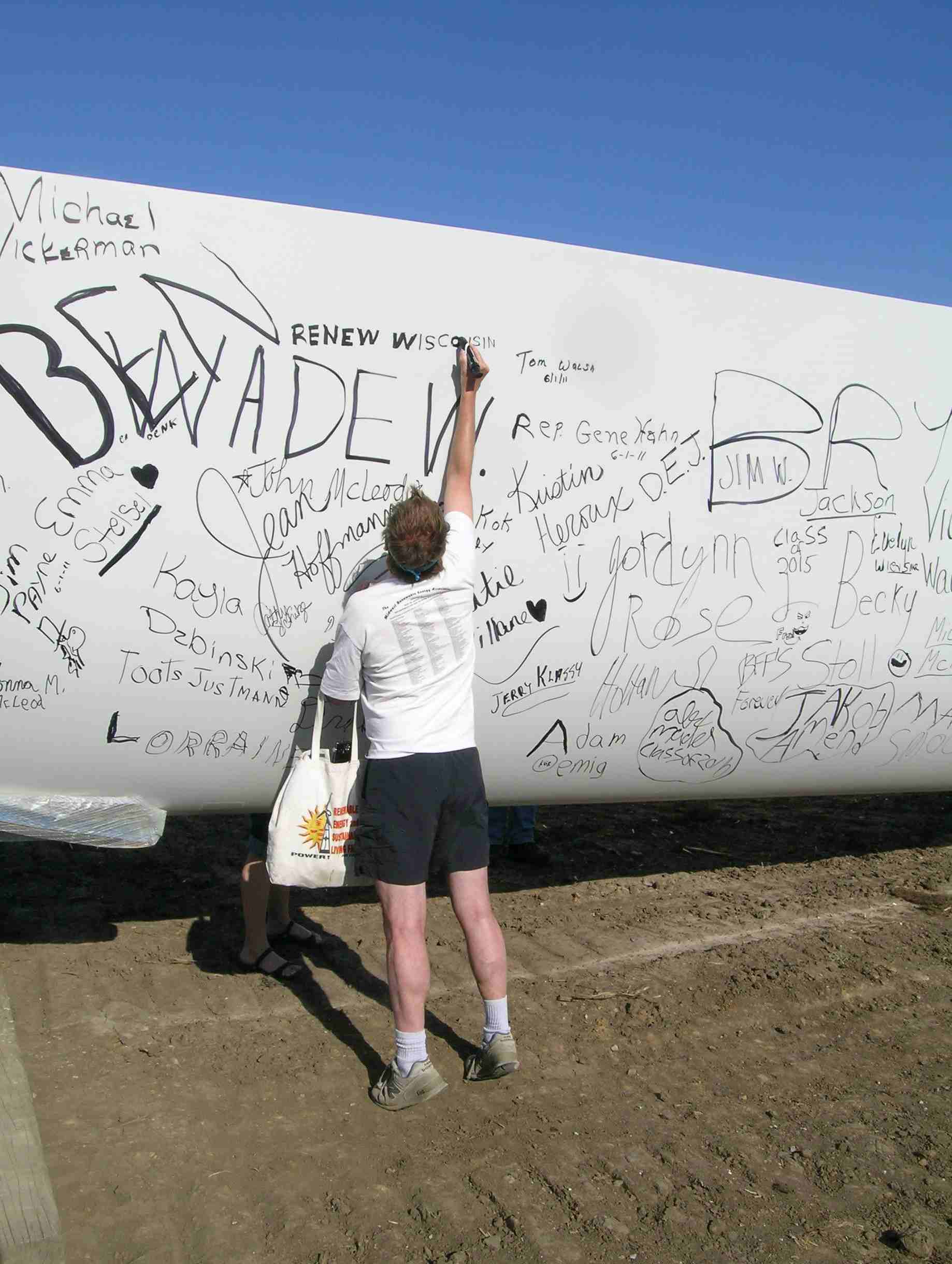
From an article by Lyn Jerde in the Portage Daily Register:
TOWN OF SCOTT - Along with names, dates and shout-outs to favorite sports teams, the writing on the turbine blade included a warning: "Watch out."
Mark Barden wrote it, in permanent black marker.
The warning, he said, is aimed at any birds that might fly near the blade once it's turning, 400 feet in the air.
Wednesday's open house at the Glacier Hills Wind Park was Barden's first up-close look at the components of the 90 electricity-generating wind turbines that have begun to rise in the skyline in northeast Columbia County.
But it won't be his last look. Barden said three of the towers will be on his land in the town of Scott, just outside of Cambria.
He said he doesn't share the health and safety concerns about the wind towers that many of their opponents cited in seeking to block the construction of Glacier Hills - things such as constant low-level noise and shadow flicker.
"I'm more worried," he said, "about the red lights at night," he said. "When I look in the sky and try to find constellations, all I'll see is the red beacons (on the towers).
"But," Barden added, "we'll deal with that."
Barden was one of several hundred people who attended the open house, which included indoor easel and tabletop displays, and a tour - on foot or by school bus - of one of the four towers that, as of Wednesday, had two of its four segments erected.
Mike Strader, site manager for the We Energies project, said that, barring wind or other inclement weather, plans call for adding the top two segments to at least one of the towers today, with the hub, cell and three blades of the turbine to follow soon.
More photos on RENEW's Facebook page.
Monday, April 27, 2009
Time for uniform wind siting rules for cleaner energy future
An editorial from the Sheboygan Press:
Wisconsin should move ahead with uniform rules and regulations for siting power-generating wind turbines that could be applied statewide.
State Sen. Jeff Plale of South Milwaukee is circulating a bill to that effect in hopes of getting bipartisan support before it is introduced in the Legislature. A similar plan was proposed late in the last legislative session and was wisely shelved because there wasn't enough time to fully explore the idea and hold public hearings.
Since this measure will take away some local control that planning and zoning rules would cover, input from local government officials, as well as the public, is critical to coming up with a workable plan.
Current state law gives the Public Service Commission the responsibility for review and approval of large wind power proposals, but smaller projects are left for local governments to decide.
Wind power is not a passing fad. It has to be a part of the solution to weaning the U.S. from fossil fuels. Until the recession hit, wind power generation was among the fastest growing industries in the nation. And, Wisconsin has chosen to be a leader, not a follower in the use of renewable sources of energy. By 2015, the goal is to have 20 percent of the electricity produced in the state come from sources other than coal- or gas-fired power plants.
It would still be best for wind turbine siting decisions to remain solely with local governments.
Neighboring Fond du Lac County is an example where it can work. Leaders in several towns have done a good job of balancing the concerns of neighboring residents with the need for renewable sources of energy in developing regulations on setbacks and noise.
But it is quite apparent that the desire to come up with reasonable rules is not universal. Some towns have written siting rules in such a way to ban wind turbine projects entirely.
There is time to conduct hearings and gather information, and a uniform set of rules on wind turbines will help Wisconsin reach a cleaner energy future sooner, rather than later.
Wisconsin should move ahead with uniform rules and regulations for siting power-generating wind turbines that could be applied statewide.
State Sen. Jeff Plale of South Milwaukee is circulating a bill to that effect in hopes of getting bipartisan support before it is introduced in the Legislature. A similar plan was proposed late in the last legislative session and was wisely shelved because there wasn't enough time to fully explore the idea and hold public hearings.
Since this measure will take away some local control that planning and zoning rules would cover, input from local government officials, as well as the public, is critical to coming up with a workable plan.
Current state law gives the Public Service Commission the responsibility for review and approval of large wind power proposals, but smaller projects are left for local governments to decide.
Wind power is not a passing fad. It has to be a part of the solution to weaning the U.S. from fossil fuels. Until the recession hit, wind power generation was among the fastest growing industries in the nation. And, Wisconsin has chosen to be a leader, not a follower in the use of renewable sources of energy. By 2015, the goal is to have 20 percent of the electricity produced in the state come from sources other than coal- or gas-fired power plants.
It would still be best for wind turbine siting decisions to remain solely with local governments.
Neighboring Fond du Lac County is an example where it can work. Leaders in several towns have done a good job of balancing the concerns of neighboring residents with the need for renewable sources of energy in developing regulations on setbacks and noise.
But it is quite apparent that the desire to come up with reasonable rules is not universal. Some towns have written siting rules in such a way to ban wind turbine projects entirely.
There is time to conduct hearings and gather information, and a uniform set of rules on wind turbines will help Wisconsin reach a cleaner energy future sooner, rather than later.
Thursday, March 27, 2008
Do wind turbines make too much noise?
Apparently the Fond du Lac Reporter filmed the new wind turbines in Fond du Lac County and posted the footage on You Tube:
http://video.aol.com/video-detail/do-wind-turbines-make-much-sound/610841121
A bubbling brook and birds can be plainly heard while the turbines spin. A passing automobile drowns out all other sound.
http://video.aol.com/video-detail/do-wind-turbines-make-much-sound/610841121
A bubbling brook and birds can be plainly heard while the turbines spin. A passing automobile drowns out all other sound.
Friday, October 12, 2012
Wind project proposed for Dane County
It's official - Check out this article
from Steven Verburg in the Wisconsin State Journal:
Epic Systems plans six wind turbines northwest of Madison
Dane County's first array of commercial wind turbines will rise hundreds of feet above the rolling hills along Highway 12 northwest of Madison under plans Epic Systems of Verona hatched over the last four weeks.
The plan had to move quickly so that Epic can take advantage of federal tax credits that expire Dec. 31, said Bruce Richards, the medical software manufacturer's director of facilities and engineering.
Six turbines — each with three 135-foot blades spinning atop a 262-foot tower — will be visible from the tall buildings in Downtown Madison, including the Capitol, and the electricity they generate will help Epic offset most of its energy needs on its sprawling Verona campus.
. . .
A geothermal system heats and cools the Verona campus, and solar panels already generate electricity. The addition of the turbines will mean the company can provide about 85 percent of its own energy needs by 2014, Richards said.
"What sticks out to me is Epic's incredible commitment to renewable energy," said Dane County Executive Joe Parisi, whose administration has expedited permits for the company.
Morse Group president Lou Rotello said his company will serve as engineering, procurement and construction contractor on the project, which will employ about 75 construction workers.
The site is a good one in part because almost all of the homes that could be affected by noise or flickering shadows from the turbine blades are occupied by family members of the landowners who are leasing their land for the towers, Rotello said.
The ridge isn't the windiest spot in the county, but studies indicate it will be gusty enough to spin the blades at 27 percent of their full-speed capacity each year, Rotello said.
The turbines have a capacity of 9.9 megawatts, which will qualify them as one of 10 "major" wind power generators in Wisconsin, said Deborah Irwin, the state Public Service Commission's renewable energy specialist.Read the full article here.
Monday, June 14, 2010
Homes waste watts of power, study finds
From an article by Tom Content in the Milwaukee Journal Sentinel:
TVs, computers, others leach energy and money
In one of the first studies of its kind, energy researchers in Madison have uncovered a simple way that most consumers can save on their electric bills: pull the plug.
The researchers set up more than 700 in-home metering devices in about 50 homes to monitor the proliferation of electronic devices in our homes, and how they affect our energy use.
Thirty years ago, federal data shows, a typical home had about three plugged-in devices. The new study shows our wall sockets are jammed, with each home hosting 30 or more devices. All told, computers, printers, televisions and other devices account for 15% to 30% of a home's total electricity use - about 20% on average, the study found.
The Energy Center of Wisconsin study was able to quantify the impact of having so many devices plugged in and ready to go - sometimes on, sometimes off, and sometimes in standby mode.
Case in point: Home computers that are left on around the clock in some cases suck power even when they're sitting idle.
"Most computers are set up to turn the monitor off after about 20 minutes," said researcher Scott Pigg. "So we turn it on and use it and walk away and come back into the room and see the monitor's off. We think: 'Well, my computer is managing its power and it's shut down.'
"What they don't realize is that two-thirds of the electricity draw is the thing that's sitting on the floor - not the thing that's sitting on the desk," he added. "And the only visual indication that you have that computer's on is a little fan noise and a little green light somewhere."
A step as simple as changing the power management settings on a home PC will take less time than running to the store and buying another energy-saving light bulb, Pigg said.
TVs, computers, others leach energy and money
In one of the first studies of its kind, energy researchers in Madison have uncovered a simple way that most consumers can save on their electric bills: pull the plug.
The researchers set up more than 700 in-home metering devices in about 50 homes to monitor the proliferation of electronic devices in our homes, and how they affect our energy use.
Thirty years ago, federal data shows, a typical home had about three plugged-in devices. The new study shows our wall sockets are jammed, with each home hosting 30 or more devices. All told, computers, printers, televisions and other devices account for 15% to 30% of a home's total electricity use - about 20% on average, the study found.
The Energy Center of Wisconsin study was able to quantify the impact of having so many devices plugged in and ready to go - sometimes on, sometimes off, and sometimes in standby mode.
Case in point: Home computers that are left on around the clock in some cases suck power even when they're sitting idle.
"Most computers are set up to turn the monitor off after about 20 minutes," said researcher Scott Pigg. "So we turn it on and use it and walk away and come back into the room and see the monitor's off. We think: 'Well, my computer is managing its power and it's shut down.'
"What they don't realize is that two-thirds of the electricity draw is the thing that's sitting on the floor - not the thing that's sitting on the desk," he added. "And the only visual indication that you have that computer's on is a little fan noise and a little green light somewhere."
A step as simple as changing the power management settings on a home PC will take less time than running to the store and buying another energy-saving light bulb, Pigg said.
Monday, September 21, 2009
Turbines' negative impact on property value "quite a reach"
From an article by Colleen Kottke in The Northwestern (Oshkosh):
In the years since the Forward Wind Energy Center came on line, "For Sale" signs have popped up all over Gerry Meyer's rural neighborhood in the town of Byron. . . .
Meyer is convinced that the aesthetically displeasing look of the 400-foot turbines and subsequent ill effects experienced by nearby residents from the noise, vibration and light-flicker has caused housing values to plummet.
A just-released study commissioned by wind-power opponents concurs, saying that property values have fallen at least 19 percent for properties located near the We Energies wind farm in Fond du Lac County and 12 percent for those located near Invenergy's Forward Wind Energy Center in Fond du Lac and Dodge counties.
The study by Appraisal Group One was commissioned by a Calumet County affiliate of the state Coalition for Wisconsin Environmental Steward, a group fighting a We Energies wind farm project in Columbia County.
'Quite a reach'
Brian Manthey, a spokesman for We Energies, said the report failed to make accurate comparisons in properties used to track declining values.
"They compared subdivision and lake view lots when the properties in our wind farm area were considered agricultural lots back in 2006. Ultimately, they figured in the sale of four lots, which is tough to draw any comparisons when using such a small scale," said Manthey, who described the report's findings as "quite a reach."
Since construction of the 88-turbine project in the Blue Sky Green Field project in the towns of Calumet and Marshfield, Manthey said 12 homes have been sold; some homes sold above assessed value while others sold below fair market values. Manthey said the report is misleading in that it doesn't take into consideration other factors impacting property values.
In the years since the Forward Wind Energy Center came on line, "For Sale" signs have popped up all over Gerry Meyer's rural neighborhood in the town of Byron. . . .
Meyer is convinced that the aesthetically displeasing look of the 400-foot turbines and subsequent ill effects experienced by nearby residents from the noise, vibration and light-flicker has caused housing values to plummet.
A just-released study commissioned by wind-power opponents concurs, saying that property values have fallen at least 19 percent for properties located near the We Energies wind farm in Fond du Lac County and 12 percent for those located near Invenergy's Forward Wind Energy Center in Fond du Lac and Dodge counties.
The study by Appraisal Group One was commissioned by a Calumet County affiliate of the state Coalition for Wisconsin Environmental Steward, a group fighting a We Energies wind farm project in Columbia County.
'Quite a reach'
Brian Manthey, a spokesman for We Energies, said the report failed to make accurate comparisons in properties used to track declining values.
"They compared subdivision and lake view lots when the properties in our wind farm area were considered agricultural lots back in 2006. Ultimately, they figured in the sale of four lots, which is tough to draw any comparisons when using such a small scale," said Manthey, who described the report's findings as "quite a reach."
Since construction of the 88-turbine project in the Blue Sky Green Field project in the towns of Calumet and Marshfield, Manthey said 12 homes have been sold; some homes sold above assessed value while others sold below fair market values. Manthey said the report is misleading in that it doesn't take into consideration other factors impacting property values.
Tuesday, March 25, 2008
Farms clean up with new crop - wind turbines
From an article by Tom Content in the Milwaukee Journal Sentinel:
Town of Marshfield - The state's newest energy crop is rising above the rolling farm fields overlooking Lake Winnebago in northeastern Fond du Lac County.While farmers throughout Wisconsin have planted more corn in recent years to make ethanol, some area farmers will soon receive payments for giving land over to another renewable resource: wind turbines.
More than 170 turbines sit atop towers in two new wind farm projects in Fond du Lac and Dodge counties. The new turbines will generate only a fraction of the state's power needs, yet they are the most significant expansion yet of the state's renewable energy efforts.
"It's our future for energy, isn't it?" said Melvin Olig of Mount Calvary as he took an afternoon walk on country roads with turbines on either side.
Proposals to build the turbines were floated five years ago, and the projects became controversial. Some homeowners worried that the towers would dramatically change the rural landscape, and they raised concerns about noise and other potential problems.
"It doesn't bother me," said Olig, who checks which way the wind is blowing each morning by looking out his kitchen window at the two turbines he can see from his home.
"Some people are quite up in arms about it, but if you're doing something that's legal on your own land, I don't have a problem with it."
Town of Marshfield - The state's newest energy crop is rising above the rolling farm fields overlooking Lake Winnebago in northeastern Fond du Lac County.While farmers throughout Wisconsin have planted more corn in recent years to make ethanol, some area farmers will soon receive payments for giving land over to another renewable resource: wind turbines.
More than 170 turbines sit atop towers in two new wind farm projects in Fond du Lac and Dodge counties. The new turbines will generate only a fraction of the state's power needs, yet they are the most significant expansion yet of the state's renewable energy efforts.
"It's our future for energy, isn't it?" said Melvin Olig of Mount Calvary as he took an afternoon walk on country roads with turbines on either side.
Proposals to build the turbines were floated five years ago, and the projects became controversial. Some homeowners worried that the towers would dramatically change the rural landscape, and they raised concerns about noise and other potential problems.
"It doesn't bother me," said Olig, who checks which way the wind is blowing each morning by looking out his kitchen window at the two turbines he can see from his home.
"Some people are quite up in arms about it, but if you're doing something that's legal on your own land, I don't have a problem with it."
Subscribe to:
Posts (Atom)